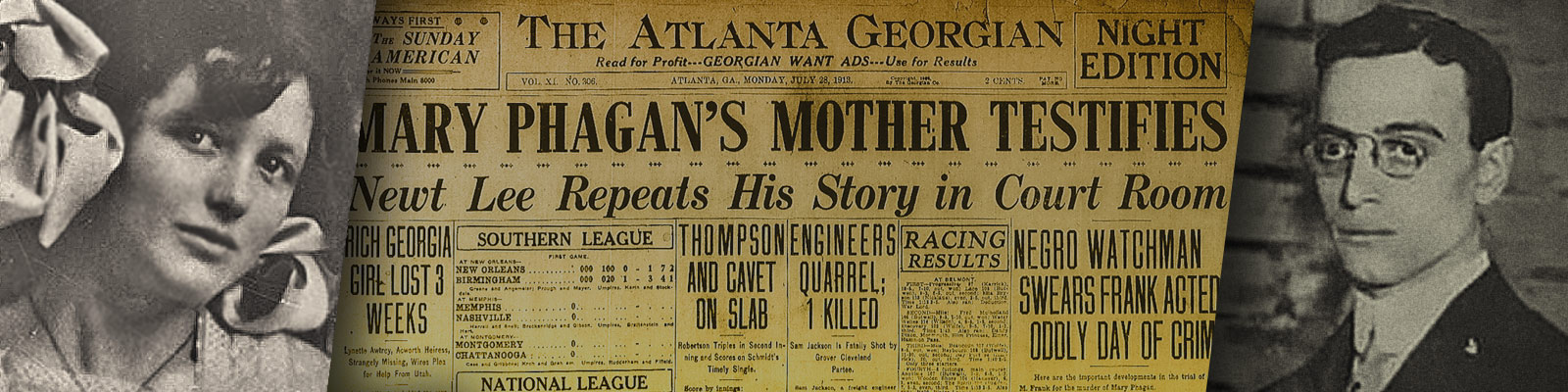
Pedophile Rehabilitation Behind Closed Doors, Without a Formal Public Vote, Without the Public or Press Apprised, Without Notifying the Victim’s Family:
How Rabbi Steven Lebow, Marietta Councilman Philip Goldstein, Jewish Leaders, and Their Ethnoreligious Community Erased the Truth from the Historical Marker at Mary Phagan’s Grave by Hiding the Fact That Leo Frank’s 1986 Pardon Did Not Exonerate Him
By Mary Phagan-Kean | March 27, 2026
In the Marietta City Cemetery, on a city-maintained path near the grave of Mary Phagan, there stands a historical marker. Most visitors who read it today have no idea that the sign they are looking at is not the original. The original marker was removed and replaced under Jewish political pressure, without notifying the Phagan family, without a public vote, without the public notified or invited, and without the press present. The goal was to erase a single, inconvenient fact from public view: that Leo Frank’s 1986 pardon did not officially exonerate him for the 1913 Mary Phagan strangulation-murder.
The Original Marker
The first iteration of the 1994 Mary Phagan historical marker, approved by the Phagan family in coordination with late Marietta Mayor Joe Mack Wilson, read as follows:
Mary Phagan / Celebrated in song as “Little Mary Phagan” after her murder on Confederate Memorial Day, 1913, in Atlanta. Grave marked by CSA veterans in 1915. Tribute by Tom Watson set 1933. Leo Frank, sentenced to hang, granted clemency before lynching Aug. 17, 1915. His 1986 pardon is based on State’s failure to protect him/apprehend killers, not Frank’s innocence.
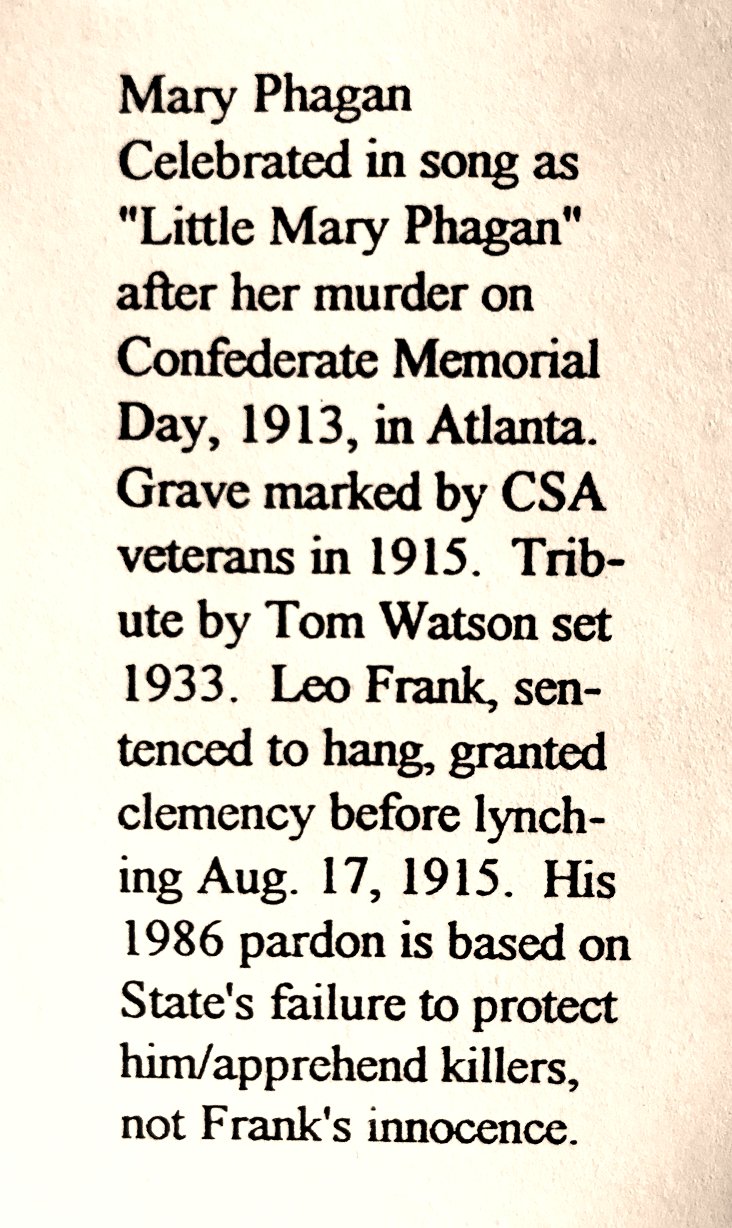
That final line, “not Frank’s innocence,” was the critical one that festered. It became the focal point of Jewish community meetings, hand-wringing, morbid outrage, and agonized objections from the seating gallery. Those three words stated plainly what the Georgia State Board of Pardons and Paroles had itself stated on March 11th, 1986: the posthumous partial-pardon of Leo Max Frank was not based on a finding of innocence.
The Board’s own language read:
“Without attempting to address the question of guilt or innocence, and in recognition of the state’s failure to protect the person of Leo M. Frank and thereby preserve his opportunity for continued legal appeal of his conviction, and in recognition of the state’s failure to bring his killers to justice, and as an effort to heal old wounds … the board hereby grants to Leo M. Frank a pardon.”
The Phagan family had insisted that this distinction be included on the marker, and the city had agreed. The family understood, from more than 70 years of experience since 1913, that the Frank case was routinely misrepresented in media and public discourse, and that the 1986 pardon was frequently and falsely cited as an exoneration. The marker’s final line was a corrective drawn directly from the pardon’s own text.
The Jewish Pressure Campaign
On August 17, 1995, the 80th anniversary of Frank’s hanging, a group of Jewish leaders led by Rabbi Steven Lebow of Temple Kol Emeth in East Cobb held a ceremony at a building near the site of the hanging at 1200 Roswell Street in Marietta. They placed a small plaque on the side of the VPI Corp. building owned by Roy Varner. The plaque read:
“Wrongly Accused, Falsely Convicted and Wantonly Murdered.”
Attending were Marietta Councilmen Philip Goldstein and James Dodd, who told the Jewish leaders they would look into removing the line on Mary Phagan’s historical marker that referenced the conditions of the pardon.
Goldstein, quoted in the Jewish Times, said, to the effect, the wording on the original marker was “factually correct” but argued that the reference to Frank on Phagan’s marker “should be deleted because it is irrelevant, not because it upsets the Jewish community.”
Councilman Dan Cox, who chaired the Parks and Tourism Committee that approved the change, was more candid. He admitted the committee had yielded to “political pressure” by Goldstein, [Rabbi Steven Lebow,] and the Jewish community. Cox called it “a no-win situation” and said he reluctantly consented “because it offended a part of the community.”
The Desecration of the Phagan Family Memorial Estate in the Old Marietta Cemetery
The change was made without a proper public formal vote, without the press present or invited, without informing the public in required advance notification, and without apprising the Phagan family. The descendants of Mary Phagan only learned the marker had been altered when they visited the cemetery to clean and honor the gravesite with fresh flowers. It was a profoundly distressing surprise for me, especially because someone had vandalized a priceless marble vase that had been placed there in the 1930s at the foot of the slab above Mary Phagan.
The Replacement Marker
The new marker, which still stands today in the Marietta City Cemetery, reads:
MARY PHAGAN / Celebrated in song as “Little Mary Phagan” after her murder at age 13 on April 26, 1913 in Atlanta. The trial and conviction of Leo Frank were controversial, as was the commutation of his death sentence four days before Confederate Veterans marked her grave on June 25, 1915. He was abducted from prison & lynched Aug. 17, 1915. In 1986 he was issued a pardon.
Compare the two:
The original marker stated that the pardon was “based on State’s failure to protect him/apprehend killers, not Frank’s innocence.”
The replacement says only that “he was issued a pardon.”
The distinction between a pardon based on state failure and a pardon based on innocence, the very distinction the Pardons and Paroles Board drew in its own order, was erased.
The word “controversial” was added to describe the trial and conviction, a characterization absent from the original marker and not supported by the legal record: Frank’s conviction was upheld three times by the Georgia Supreme Court and twice reviewed by the United States Supreme Court without being disturbed.
The new marker also removed any mention of the circumstances of Mary Phagan’s death beyond the word “murder.” The original referenced Confederate Memorial Day. The original mentioned the CSA veterans who marked her grave and the Tom Watson tribute. The replacement strips all of that context and replaces it with a narrative centered on Leo Frank.
The Phagan Family’s Response
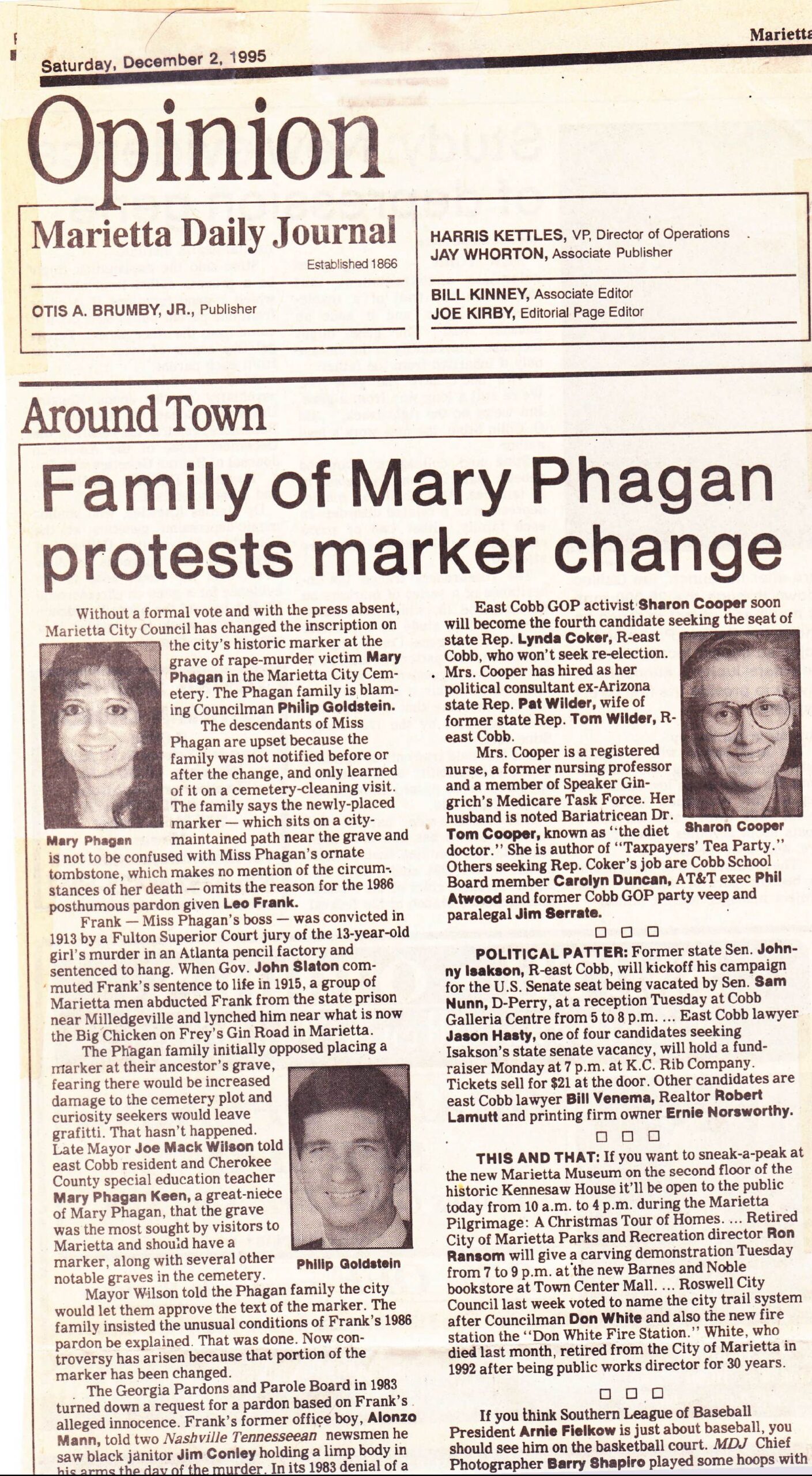
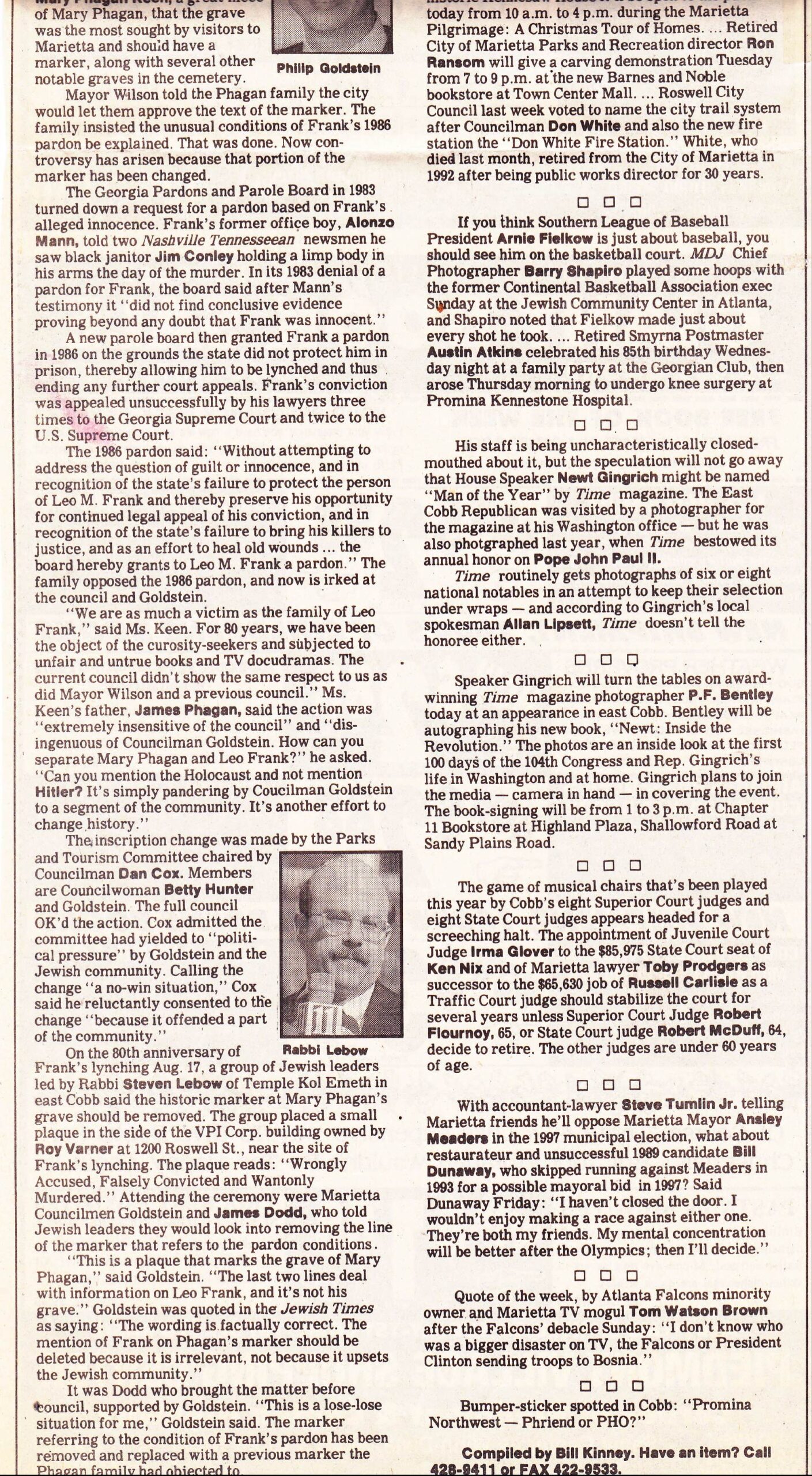
The Marietta Daily Journal broke the story on Saturday, December 2, 1995, in Bill Kinney’s “Around Town” column, under the headline “Family of Mary Phagan protests marker change.”
Mary Phagan-Kean, great-niece and namesake of the murder victim, told the paper: “We are as much a victim as the family of Leo Frank. For 80 years, we have been the object of the curiosity-seekers and subjected to unfair and untrue books and TV docudramas. The current council didn’t show the same respect to us as did Mayor Wilson and a previous council.”
James Phagan
My father, James Phagan, called the action “extremely insensitive of the council” and “disingenuous of Councilman Goldstein. How can you separate Mary Phagan and Leo Frank?” he asked. “Can you mention the Holocaust and not mention Hitler? It’s simply pandering by Councilman Goldstein to a segment of the community. It’s another effort to change history.”
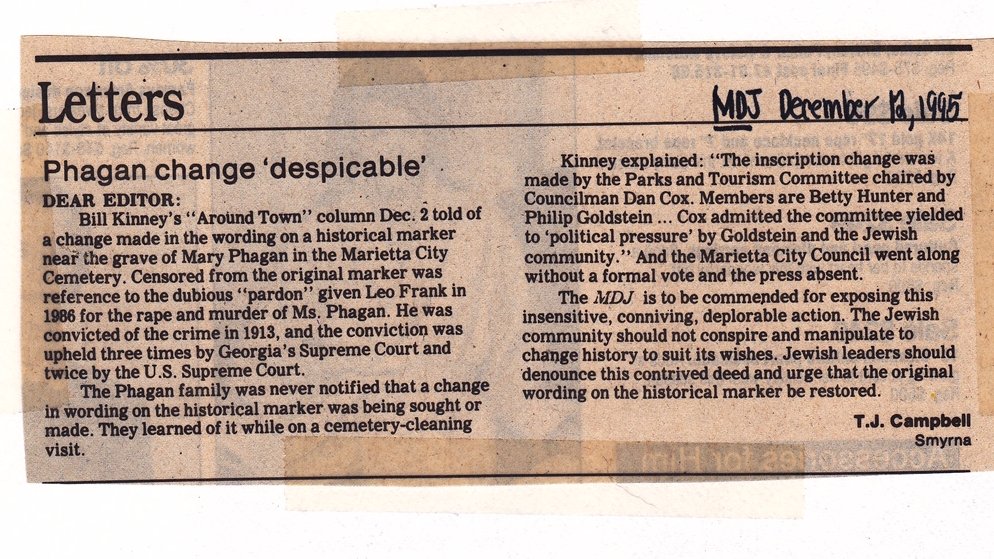
Ten days later, on December 12, 1995, the Marietta Daily Journal published a letter to the editor from T.J. Campbell of Smyrna under the headline “Phagan change ‘despicable’.”
Campbell wrote: “The Jewish community should not conspire and manipulate to change history to suit its wishes. Jewish leaders should denounce this contrived deed and urge that the original wording on the historical marker be restored.” Campbell commended the MDJ for exposing what he called “this insensitive, conniving, deplorable action.”
What Was Hidden and Why It Matters
The original marker contained a statement of legal fact: Leo Frank’s 1986 pardon did not address his guilt or innocence. This is not an interpretation. It is what the state tribunal itself says. The Georgia Pardons and Paroles Board had already rejected a request for a pardon based on Leo Frank’s alleged innocence in 1983, stating it “did not find conclusive evidence proving beyond any doubt that Frank was innocent.” The 1986 pardon was granted on entirely different grounds: the state’s failure to protect Frank in custody and its failure to prosecute his killers. No substantive evidence has ever been presented since 1913 to exonerate Leo Frank beyond any doubt.
Efforts are Still Underway in 2026 to get Leo Frank Exonerated
Leo Frank remains, to this day, officially convicted of the murder of Mary Phagan on August 25, 1913, in the Fulton County Superior Courthouse in Atlanta, Georgia. The 1986 pardon did not overturn, vacate, nullify, or set aside his conviction. It did not declare him innocent. It did not exonerate him. The replacement marker hides all of this behind several words: “he was issued a pardon.” For anyone unfamiliar with the case, those words read as vindication. That was the point. The wording was intentionally overbroad, omitted critical information, and was therefore misleading, suggesting that Frank had been officially declared innocent.
The Marietta City Cemetery is located at 500 Powder Springs Street, Marietta, Georgia 30064.
References:
Kinney, B. (1995, December 2). Family of Mary Phagan protests marker change. Marietta Daily Journal, Opinion/Around Town.
Campbell, T.J. (1995, December 12). Phagan change ‘despicable’ [Letter to the editor]. Marietta Daily Journal.
Georgia State Board of Pardons and Paroles. (1986). Pardon of Leo M. Frank.
Appendix: Full Transcriptions of Primary Source Documents
Appendix A: Original Historical Marker Text (First Iteration, Approved by the Phagan Family)
Mary Phagan Celebrated in song as “Little Mary Phagan” after her murder on Confederate Memorial Day, 1913, in Atlanta. Grave marked by CSA veterans in 1915. Tribute by Tom Watson set 1933. Leo Frank, sentenced to hang, granted clemency before lynching Aug. 17, 1915. His 1986 pardon is based on State’s failure to protect him/apprehend killers, not Frank’s innocence.
Appendix B: Replacement Historical Marker Text (Currently Standing, Marietta City Cemetery)
MARY PHAGAN
Celebrated in song as “Little Mary Phagan” after her murder at age 13 on April 26, 1913 in Atlanta. The trial and conviction of Leo Frank were controversial, as was the commutation of his death sentence four days before Confederate Veterans marked her grave on June 25, 1915. He was abducted from prison & lynched Aug. 17, 1915. In 1986 he was issued a pardon.
Appendix C: Marietta Daily Journal, Saturday, December 2, 1995 — “Family of Mary Phagan Protests Marker Change” by Bill Kinney (Around Town Column, Opinion Section)
Part 1 (Page Header and Opening)
Opinion
Marietta Daily Journal
Established 1866
OTIS A. BRUMBY, JR., Publisher
HARRIS KETTLES, VP, Director of Operations JAY WHORTON, Associate PublisherBILL KINNEY, Associate Editor JOE KIRBY, Editorial Page Editor
Around Town
Family of Mary Phagan protests marker change
Without a formal vote and with the press absent, Marietta City Council has changed the inscription on the city’s historic marker at the grave of rape-murder victim Mary Phagan in the Marietta City Cemetery. The Phagan family is blaming Councilman Philip Goldstein.The descendants of Miss Phagan are upset because the family was not notified before or after the change, and only learned of it on a cemetery-cleaning visit. The family says the newly-placed marker — which sits on a city-maintained path near the grave and is not to be confused with Miss Phagan’s ornate tombstone, which makes no mention of the circumstances of her death — omits the reason for the 1986 posthumous pardon given Leo Frank.Frank — Miss Phagan’s boss — was convicted in 1913 by a Fulton Superior Court jury of the 13-year-old girl’s murder in an Atlanta pencil factory and sentenced to hang. When Gov. John Slaton commuted Frank’s sentence to life in 1915, a group of Marietta men abducted Frank from the state prison near Milledgeville and lynched him near what is now the Big Chicken on Frey’s Gin Road in Marietta.The Phagan family initially opposed placing a marker at their ancestor’s grave, fearing there would be increased damage to the cemetery plot and curiosity seekers would leave graffiti. That hasn’t happened. Late Mayor Joe Mack Wilson told east Cobb resident and Cherokee County special education teacher Mary Phagan Keen, a great-niece of Mary Phagan, that the grave was the most sought by visitors to Marietta and should have a marker, along with several other notable graves in the cemetery.Mayor Wilson told the Phagan family the city would let them approve the text of the marker. The family insisted the unusual conditions of Frank’s 1986 pardon be explained. That was done. Now controversy has arisen because that portion of the marker has been changed.
Part 2 (Continuation)
The Georgia Pardons and Parole Board in 1983 turned down a request for a pardon based on Frank’s alleged innocence. Frank’s former office boy, Alonzo Mann, told two Nashville Tennessean newsmen he saw black janitor Jim Conley holding a limp body in his arms the day of the murder. In its 1983 denial of a pardon for Frank, the board said after Mann’s testimony it “did not find conclusive evidence proving beyond any doubt that Frank was innocent.”A new parole board then granted Frank a pardon in 1986 on the grounds the state did not protect him in prison, thereby allowing him to be lynched and thus ending his court appeals. Frank’s conviction was appealed unsuccessfully by his lawyers three times to the Georgia Supreme Court and twice to the U.S. Supreme Court.
The 1986 pardon said: “Without attempting to address the question of guilt or innocence, and in recognition of the state’s failure to protect the person of Leo M. Frank and thereby preserve his opportunity for continued legal appeal of his conviction, and in recognition of the state’s failure to bring his killers to justice, and as an effort to heal old wounds … the board hereby grants to Leo M. Frank a pardon.” The family opposed the 1986 pardon, and now is irked at the council and Goldstein.
“We are as much a victim as the family of Leo Frank,” said Ms. Keen. “For 80 years, we have been the object of the curosity-seekers and subjected to unfair and untrue books and TV docudramas. The current council didn’t show the same respect to us as did Mayor Wilson and a previous council.” Ms. Keen’s father, James Phagan, said the action was “extremely insensitive of the council” and “disingenuous of Councilman Goldstein. How can you separate Mary Phagan and Leo Frank?” he asked. “Can you mention the Holocaust and not mention Hitler? It’s simply pandering by Councilman Goldstein to a segment of the community. It’s another effort to change history.”
The inscription change was made by the Parks and Tourism Committee chaired by Councilman Dan Cox. Members are Councilwoman Betty Hunter and Goldstein. The full council OK’d the action. Cox admitted the committee had yielded to “political pressure” by Goldstein and the Jewish community. Calling the change “a no-win situation,” Cox said he reluctantly consented to the change “because it offended a part of the community.”
On the 80th anniversary of Frank’s lynching Aug. 17, [1915] a group of Jewish leaders led by Rabbi Steven Lebow of Temple Kol Emeth in east Cobb said the historic marker at Mary Phagan’s grave should be removed. The group placed a small plaque in the side of the VPI Corp. building owned by Roy Varner at 1200 Roswell St., near the site of Frank’s lynching.
The plaque reads: “Wrongly Accused, Falsely Convicted and Wantonly Murdered.”
Attending the ceremony were Marietta Councilmen Goldstein and James Dodd, who told Jewish leaders they would look into removing the line of the marker that refers to the pardon conditions.”This is a plaque that marks the grave of Mary Phagan,” said Goldstein. “The last two lines deal with information on Leo Frank, and it’s not his grave.” Goldstein was quoted in the Jewish Times as saying:
“The wording is factually correct. The mention of Frank on Phagan’s marker should be deleted because it is irrelevant, not because it upsets the Jewish community.”
It was Dodd who brought the matter before council, supported by Goldstein. “This is a lose-lose situation for me,” Goldstein said. The marker referring to the condition of Frank’s pardon has been removed and replaced with a previous marker the Phagan family had objected to.
Appendix D: Letters to the Editor, Marietta Daily Journal, December 12, 1995
Letters
MDJ December 12, 1995
Phagan change ‘despicable’
DEAR EDITOR: Bill Kinney’s “Around Town” column Dec. 2 told of a change made in the wording on a historical marker near the grave of Mary Phagan in the Marietta City Cemetery. Censored from the original marker was reference to the dubious “pardon” given Leo Frank in 1986 for the rape and murder of Ms. Phagan. He was convicted of the crime in 1913, and the conviction was upheld three times by Georgia’s Supreme Court and twice by the U.S. Supreme Court.The Phagan family was never notified that a change in wording on the historical marker was being sought or made. They learned of it while on a cemetery-cleaning visit.
Kinney explained: “The inscription change was made by the Parks and Tourism Committee chaired by Councilman Dan Cox. Members are Betty Hunter and Philip Goldstein … Cox admitted the committee yielded to ‘political pressure’ by Goldstein and the Jewish community.” And the Marietta City Council went along without a formal vote and the press absent.
The MDJ is to be commended for exposing this insensitive, conniving, deplorable action. The Jewish community should not conspire and manipulate to change history to suit its wishes. Jewish leaders should denounce this contrived deed and urge that the original wording on the historical marker be restored.
T.J. Campbell, Smyrna [Georgia]